
Navigating the Data-Driven Economy with Business Analytics
- 17th April, 2025
- |
- Author: N. L. Dalmia
The ability to make informed decisions quickly and accurately is more crucial than ever. This is where the concept of a data-driven decision-making process comes into play. By leveraging data, businesses can enhance their strategies, improve operations and ultimately achieve significant competitive advantages. This blog will explore how business analytics facilitates data-driven decision-making in business, highlighting the importance and advantages of this approach. We will also discuss how pursuing a PG Diploma in Business Analytics can be a steppingstone towards becoming proficient in this critical skill.
What is Data-Driven Decision Making?
So, what is data-driven decision-making? Data-driven decision-making (DDDM) is based on data analysis rather than intuition or observation alone. In simple terms, rather than going with your gut feeling or past experiences, you use hard data to back up your business decisions. This method allows for more accurate, reliable and transparent decisions.
Why Data-Driven Decision-Making is Important?
The importance of data-driven decision-making must be considered in the current business climate. Here are a few reasons why data-driven decision-making is important:
- Improved accuracy: Data-driven decisions are typically more accurate since they are based on analysed data rather than assumptions. This reduces the risk of errors that can come from biased or uninformed decisions.
- Enhanced efficiency: Data-based decisions eliminate the need for guesswork, making the decision-making process quicker and more efficient.
- Better outcomes: Businesses can expect better outcomes with more accurate decisions. This could mean higher sales, better customer satisfaction, or even cost savings.
- Predictive insights: Data allows businesses to predict future trends and behaviours. This predictive capability can be a powerful tool in planning and strategy.
- Objective decisions: Data provides an objective foundation for decisions, which helps in reducing personal bias in business operations.
Advantages of Data-Driven Decision-Making
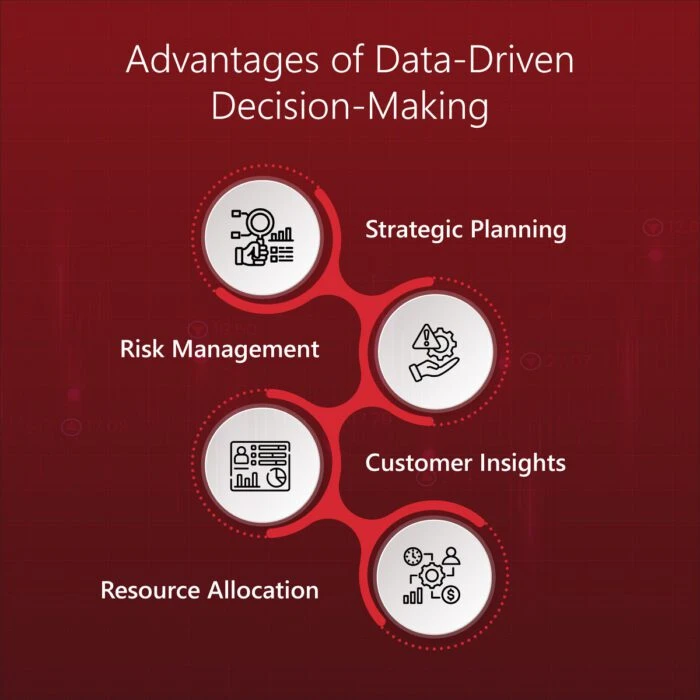
This shift brings several advantages of data-driven decision-making that can transform how a business operates:
- Strategic planning: Data helps in identifying patterns, trends and insights that can inform strategic planning and decision-making.
- Risk management: By analysing data, businesses can anticipate potential risks and take preventive measures.
- Customer insights: Data analysis helps in understanding customer preferences and behaviors, leading to better customer service and tailored products.
- Resource allocation: Data helps businesses allocate their resources more effectively, ensuring that investments are made where they are most likely to generate returns.
Business Analytics for Data-Driven Decision Making
Business analytics is an essential tool for data-driven decision-making. It involves the skills, technologies and practices for continuous iterative exploration and investigation of past business performance to gain insight and drive business planning. Business analytics for data-driven decision-making uses data and statistical methods to provide actionable insights for decision-makers.
For instance, a company might use business analytics to determine the most effective marketing strategies by analysing customer response rates or to optimise its supply chain by predicting the best times to order materials based on historical data.
Data-Driven Decision-Making in Business
In the context of business, data-driven decision-making involves several key processes and techniques:
Data collection: Gathering accurate and relevant data from various sources.
Data analysis: Using statistical tools and algorithms to make sense of the data collected.
Data interpretation: Translating analysis results into understandable and actionable business insights.
Decision implementation: Applying these insights to make real-world business decisions.
How Organisations Adapt to Data-driven Cultures
One of the significant challenges businesses face when transitioning to a data-driven approach is the cultural shift required. Organisations must foster a culture where data is at the heart of every operation and decision-making process. Here’s how companies can embrace this change effectively:
- Education and Training: Investing in education and training ensures that all levels of the organisation understand the importance of data and analytics. This can involve workshops, seminars and hands-on training sessions.
- Investing in Technology: Adopting the right tools and technologies is crucial for effective data analysis. This could range from advanced analytics software to more robust data storage solutions.
- Promoting Transparency: By making data accessible to all stakeholders, businesses can promote transparency and encourage more employees to engage in data-driven decision-making.
- Encouraging Collaboration: Data-driven cultures thrive on collaboration. Teams across different departments should be encouraged to share insights and data to foster a more integrated approach to problem-solving.
Overcoming Challenges in Data-Driven Decision Making
While the benefits are clear, the path to becoming a data-driven organisation is not without its challenges. Some of these challenges include:
- Data Quality and Quantity: Having too much data can be as problematic as having too little. Ensuring that data is relevant, accurate and of high quality is crucial.
- Resistance to Change: In many organisations, there can be resistance to change, especially from those who have relied on traditional decision-making processes.
- Privacy and Security: With the increasing amount of data, privacy and security concerns are more prominent. Organisations must ensure they comply with laws and regulations regarding data handling.
Addressing these challenges requires a strategic approach and the willingness to invest in both technology and human capital.
The Future of Data-Driven Decision Making
As technology continues to evolve, the potential for data-driven decision-making grows. The future is likely to see more advanced forms of analytics, such as artificial intelligence (AI) and machine learning (ML), which can predict patterns and make decisions in real time. Organisations that continue to invest in and prioritise data analytics will likely maintain a significant edge in the market.
PG Diploma in Business Analytics: A Pathway to Mastery
For those looking to build a career in this field, a PG Diploma in Business Analytics can be an excellent pathway. This program typically covers essential aspects such as statistical analysis, data management, business intelligence and advanced analytics. Through this diploma, students can acquire the necessary skills to effectively apply business analytics in real-world scenarios, thus making data-driven decision-making a key part of their professional toolkit.
Conclusion
To build a data-driven legacy, businesses need to evolve and adapt their strategies based on data insights continuously. This involves adopting new technologies and ensuring that the entire organisation understands and embraces the value of data-driven decision-making. A PG Diploma in Business Analytics could be your first step towards becoming a leader in this transformative environment. Top-ranked institutes like N. L. Dalmia, give your management dreams perfect wings. Furthermore, the institute’s PGDM program is approved by the All-India Council for Technical Education (AICTE) and AIU making it equivalent to an MBA in terms of governmental and academic recognition. This accreditation assures students that their education is rigorous and meets high standards.
The journey towards integrating data-driven decision-making in business is complex but rewarding. By committing to this path, businesses can ensure they remain competitive and relevant in an increasingly data-centric world. Remember, in the journey of data-driven decision-making, every bit of data counts towards crafting a smarter, more efficient business landscape.
Related Blogs

How AI is Transforming PGDM Education & Business Schools in India
- 27th May, 2026
- MBA, MBA Advice
Artificial Intelligence is changing how you learn and how you prepare for your career. Business schools in India are adapting fast. You now see a shift in how AI in PGDM education shapes curriculum, …
Learn More
Top PGDM College in India: A Complete Guide to PGDM Programs, Admissions & Careers
- 26th May, 2026
- MBA, MBA Advice
You plan your career after graduation and you face confusion. You see many options like MBA, PGDM and specialised programs. You also see hundreds of colleges across India. This makes your decision di…
Learn More
PGDM in Finance: Eligibility, Career Opportunities & Placement Trends
- 30th April, 2026
- MBA, MBA Advice
Finance is widely seen as a stable and high-growth career path. With rising salaries in banking and fintech, many students consider whether a PGDM in Finance is the right step forward. India’s manage…
Learn More