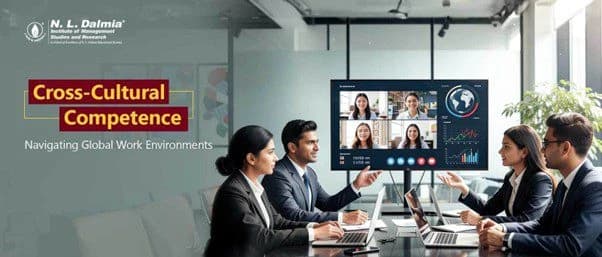
Cross-Cultural Competence: Navigating Global Work Environments
- 2nd April, 2026
- |
- Author: N. L. Dalmia
In today’s business world, borders are becoming invisible. You are no longer limited by geography when it comes to career opportunities. Companies across the world are looking for professionals who can work with diverse teams and handle international clients with ease. But stepping into a multicultural workspace is not just about speaking English or travelling abroad. It demands strong multicultural workplace skills and a clear understanding of how different cultures think, work and communicate.
The Challenge of Global Teams
Imagine this: You are in a virtual meeting with team members from Germany, Japan and Brazil. Each person has their own way of expressing opinions, responding to authority and handling feedback. Without cross-cultural competence in management, this can lead to miscommunication, tension or even project failure. Many young professionals find themselves unprepared when they enter such global settings for the first time.
Studies show that 89% of failures in international assignments are due to lack of cultural understanding, not technical skills. You may be brilliant at marketing or finance, but if you fail to connect with a colleague from another culture, the result is poor collaboration.
Why Just Knowledge Isn’t Enough
You might think reading books or watching documentaries is enough to prepare. But cultural behaviour is often subtle. A simple nod, a pause before replying or a direct tone can mean something very different across cultures. Global businesses expect you to be aware of these differences and adapt accordingly.
You also need to understand how leadership, teamwork and conflict resolution work in different regions. What works in an Indian team may not work with a European one. Without strong global work environment skills, you risk losing your competitive edge.
How You Can Build Cross-Cultural Competence
The good news is that you can learn and build these skills over time. The right learning environment plays a big role. You need real exposure, not just theory. This is where choosing the right management institute becomes crucial.
At N. L. Dalmia Institute of Management Studies and Research, you are not only taught how to think globally, you are immersed in it.
Here’s how you can grow into a globally ready professional:
1. Choose a PGDM That Builds Global Readiness
A strong PGDM should help you build a broader business perspective. At N. L. Dalmia, the PGDM program focuses on real-world learning, leadership, and analytical thinking. You gain insights from a curriculum aligned with industry needs and are mentored by experienced faculty who have worked across sectors.
This approach prepares you to work in multicultural environments and develop a global mindset, which is essential if you aim to lead teams in dynamic, diverse business settings.
2. Explore a Global MBA Path
If you want even more in-depth international experience, the Global MBA program at N. L. Dalmia is a smart option. In this unique 1+1 structure, you spend the first year in India and the second year at a partner university in the USA, UK, Canada or South Korea. You are placed right at the centre of global classrooms and corporate networks.
It’s not just about studying abroad. It’s about building the mindset to lead anywhere in the world.
3. Learn from a Diverse Faculty
You cannot gain cross-cultural competence in management without learning from people who have lived and worked in global settings. At N. L. Dalmia Institute, you are mentored by highly qualified doctorate faculty from IIMs and IITs and industry professionals who have experience in international markets. This helps you understand real-world cultural dynamics and business practices.
4. Develop People Skills Through Real Engagement
Soft skills play a vital role in global workspaces. The Institute encourages civic engagement through rural and social immersion projects. These programs help you build empathy, adaptability and strong communication skills – traits that are key in any global team.
5. Practise Daily in a Multicultural Learning Environment
You learn more when your peer group is diverse. N. L. Dalmia Institute attracts students from across India and abroad. This naturally helps you observe, interact and learn from different perspectives on a daily basis.
What You Gain with Multicultural Skills
When you develop multicultural workplace skills, you are ready for roles that involve:
- Managing global client accounts
- Leading international marketing teams
- Setting up business units abroad
- Working with cross-border project teams
You are also more likely to be noticed by global recruiters. Companies want employees who can understand and work in culturally rich environments. According to a report by McKinsey, companies with diverse teams are 35% more likely to outperform their competitors.
How N. L. Dalmia Institute Gives You the Edge
In a market flooded with B-schools, choosing the right one matters. N. L. Dalmia Institute of Management Studies and Research stands apart with:
- PGDM programs equivalent to MBA, accredited nationally and internationally
- Prestigious ESG certification through South Asia’s largest Bloomberg Lab
- Focus on techno-managerial skills for dynamic leadership
- Strong global linkages with reputed universities
- Up to 100% scholarships for deserving students who excel in academics and leadership
All of this ensures that you are not just job-ready, but future-ready.
Your Next Step Towards a Global Career
If you aim to work with global companies or lead multicultural teams, start building your cross-cultural competence now. It’s not an optional skill anymore. It’s a must-have.
Make sure your learning environment pushes you to explore, adapt and grow. Choose a PGDM or Global MBA that prepares you for the world, not just the job market.
Explore the global advantage at N. L. Dalmia Institute. Your international career journey begins here.
Related Blogs
How AI is Transforming PGDM Education & Business Schools in India
- 27th May, 2026
- MBA, MBA Advice
Artificial Intelligence is changing how you learn and how you prepare for your career. Business schools in India are adapting fast. You now see a shift in how AI in PGDM education shapes curriculum, …
Learn More
Top PGDM College in India: A Complete Guide to PGDM Programs, Admissions & Careers
- 26th May, 2026
- MBA, MBA Advice
You plan your career after graduation and you face confusion. You see many options like MBA, PGDM and specialised programs. You also see hundreds of colleges across India. This makes your decision di…
Learn More
PGDM in Finance: Eligibility, Career Opportunities & Placement Trends
- 30th April, 2026
- MBA, MBA Advice
Finance is widely seen as a stable and high-growth career path. With rising salaries in banking and fintech, many students consider whether a PGDM in Finance is the right step forward. India’s manage…
Learn More